Code
Whiteboarding in interviews
 NYC viewpoint from Ellis Island.
A long time ago, I was asked to perform a programming function (FizzBuzz) on a whiteboard during an interview with T-SQL. I was able to get the theory behind it, but I am pretty poor at memorizing syntax. I’d rather spend my time studying concepts, theory, and technology. Indexes and cursors are two great examples. I don’t think it really matters if you don’t memorize how to write those by hand, it’s more valuable to understand how they work instead.
Pass multiple values to case when expression
There may be a time when you want to pass multiple values to a CASE WHEN expression. Here’s an example, take this simple data set below:
CREATE TABLE [Test] ([UserID] INT, [Approval] VARCHAR(10) ); INSERT INTO [Test] VALUES (1, 'Reject'), (2, 'Approve'), (3, 'test'), (4, 'test2'), (5, 'Approve'), (6, 'Reject'); SELECT * FROM [Test];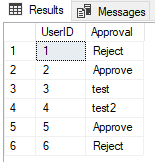 Our base data set we will use as an example.
Identify and resolve “Adding a value to a ‘date’ column caused an overflow”
This is similar to my other post on how to identify conversion problems, but here’s the catch, we don’t always get a “CASE WHEN” statement or “TRY-CONVERT / CAST” function to help us! This makes it a little bit tricky to identify your problem rows, but we’ll tackle that together.
Let’s create a basic table to illustrate the point. We’ll have an ID column so we can identify our rows easily and we’ll have another column holding our date value. But before we go too far into this setup, what would be an example where you would receive such an error?
Identify and resolve “Conversion failed when converting the varchar value ‘Something’ to data type int”
If you are seeing an error similar to “Conversion failed when converting the varchar value ‘something’ to data type int.”, I find the easiest method for identifying a solution to the problem is to analyze the data causing the error.
To illustrate how I identify bad data when making conversions, consider the environment setup below:
DECLARE @table TABLE (id VARCHAR(4));
INSERT INTO @table (id)
VALUES ('1' -- id - int
    )
     , ('NULL')
     , (NULL);
We have a simple table with a single column. The column type is a varchar(4) that allows NULL entries. We have inserted a 1, NULL, and the word “NULL”. Here’s what our table looks like:
Properly reference your columns!
 Wait, I should always what?!
If you don’t read the rest of this setup, I want you to take away one thing.
Always reference your tables with your columns when more than one table is involved in the query!
This post is made primarily with SQL Server in mind, but this behavior is actually ANSI SQL and can be replicated in PostgreSQL, MySQL, and Oracle.
T-SQL Tuesday #110 Automate your Toggl dataset with SSIS
Something I’ve automated* recently was my import of Toggl data! So T-SQL Tuesday #110 seems like a great time to post this solution. Thank you Garry Bargsley for the great idea and being this months host!
I put an asterisks next to automated, as obtaining the file from Toggl and placing its location is not automatic. They provide a premium feature to allow this or you could work on creating your own web scraper. (Which is probably against their rules of use on their site, since they are offering the file drop as a premium feature.)
How to stop the SQL Scheduler with T-SQL
A user had a unique issue where their system would have dynamically changing job names and schedules, but they need to disable and re-enable them during maintenance. Obviously, this is a huge headache.
I made a recommendation that they should ultimately create a list of currently enabled jobs that had a schedule using a system query.
SELECT *
FROM MSDB.dbo.sysschedules ss
     INNER JOIN msdb.dbo.sysjobschedules jss
	 ON jss.schedule_id = ss.schedule_id
WHERE ss.enabled = 1;
The code above returns all schedules that are paired to a job that are enabled. The enabled = 1 flag and the inner join to the sysjobschedules table are what dictate those filters.
How to learn and implement Change Tracking in SQL Server
Why would you pick Change Tracking as a technology to use?
This allows you to detect changes in a lightweight manner via T-SQL functions to extract information about DML changes to Change Tracking enabled tables. Change Data Capture is more about auditing or creating a historical view utilizing the Transaction Log and Temporal Tables are the next step up from there which became available in 2016 versions of SQL Server. Change Tracking is primarily used for finding only things that have changed. Not necessarily why, how, or who changed it, but what has changed and what it is now.
How do I dynamically populate a dropdown list for users to filter a report in SSRS?
I was helping someone who had an interesting data set. Their tables were coming from a vendor and they had to report off of those tables. The problem was that the tables were all named and logically split by MMYYYY. This meant that if they wanted to query data between a date range, they would need to maintain views daily or get creative in SSRS.
Now this option can be used for many things, you just need to tweak the parameters a little. I’m showing you conceptually how to use the template to execute a dynamic SQL Script that populate a data set from a user selecting drop downs in a report. The parameters are tables that are named to match the date range of data contained within them in this example.
How I resolved “Recovery_Pending State” which occurred while moving SQL Server files
I ran into an issue lately while moving some files around. “Recovery Pending State” in SQL Server is what I kept bumping my head against.
My goal was to move my files on my desktop to a new drive since I received a replacement. TempDB needed to be altered for the location but I didn’t need to move those files since SQL Server re-creates them. (You can’t back them up either!)